Traditional Chinese Seamless Pattern
First Impressions: Elegant, Rhythmic, and Deeply Cultural
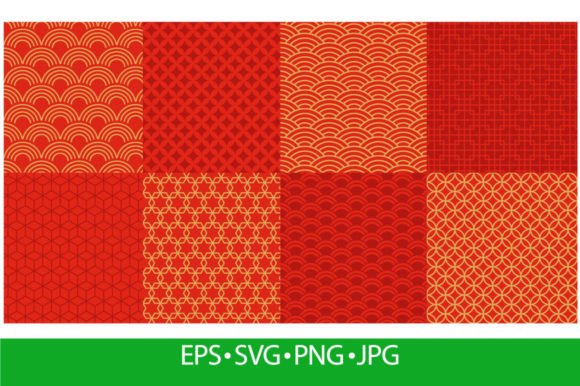
When I opened Traditional Chinese Seamless Pattern, what struck me wasn’t just the red-and-gold palette—it was the quiet confidence in its rhythm. The wave motifs aren’t literal ocean swells; they’re stylized, flowing abstractions that echo classical ink wash brushwork—fluid yet precise, decorative but never fussy. The golden Asian background isn’t flat gold foil; it’s a subtle, warm tone that breathes beneath the ornamentation. This isn’t “Asian-inspired” wallpaper—it feels authentically rooted, with restraint and intention. As an embroidery designer who’s stitched everything from minimalist monograms to dense floral borders, I immediately saw its potential on a linen tea towel, a silk-lined baby blanket, or the curved front panel of a structured tote bag.
Real Project Test: A Custom Embroidered Tote for a Boutique Launch
Last month, I used Traditional Chinese Seamless Pattern as the central motif for a limited-run embroidered canvas tote—intended for a local gift shop’s Lunar New Year collection. We scaled it to 8" wide across the front panel, repeating it once horizontally with a soft fade at the seam. The result? Customers paused. Not just glanced—*paused*. They ran fingers over the satin-stitched wave crests and commented on how “rich but not loud” it felt. That’s the quiet power of this pattern: it carries cultural weight without shouting, and its seamless nature means no awkward breaks or visible repeats—even when stitched across fabric grain shifts.
Where It Shines (and Where It Needs Thought)
- Custom apparel: Works beautifully on medium-weight cotton sweatshirts and structured twill caps—especially when placed on the left chest or back yoke. The wave flow follows natural garment contours.
- Baby embroidery: Ideal for organic cotton onesies or muslin swaddle blankets—but only if stitched with ultra-soft thread and minimal fill density. Avoid dense satin areas near seams where friction occurs.
- Embroidered patch: Excellent candidate for iron-on or sew-on patches. Its clean vector origin (EPS/SVG) holds crisp edges even at 2.5"–3" sizes—no pixelation, no fuzzy corners.
- Holiday & wedding gifts: Adds quiet sophistication to pillow covers, napkin sets, or handkerchiefs. Red-and-gold reads festive without leaning into cliché—perfect for modern couples wanting tradition with subtlety.
- Etsy & small shop product: Stands out in digital mockups. Looks premium in printable mockups on beige linen or charcoal wool—no need for heavy filters or overlays.
Use With Care: Practical Embroidery Realities
This isn’t a one-size-fits-all embroidery file. Its elegance depends on thoughtful execution:
- Small hoop sizes: Don’t force the full repeat into a 4×4 hoop. Instead, isolate one wave unit or use it as a border—stitching the entire seamless tile in tight spaces risks lost detail and thread breaks.
- Textured or stretchy fabric: On terry cloth towels or jersey knit tees, stabilize aggressively—cutaway + tear-away combo is non-negotiable. The fine line work in the wave outlines needs firm support.
- Dark fabric: Gold thread can mute on black or navy. Test first with metallic or high-sheen rayon. Consider swapping gold for burnt orange or deep rust for contrast and warmth.
- Curved surfaces (like caps): Avoid placing the most intricate part—the interwoven wave junctions—directly over the crown seam. Distortion there blurs the design’s clarity.
- Frequent washing: If stitching for kitchen towels or baby items, keep fill stitch density moderate. Overly dense areas will stiffen and crack after 5–6 wash cycles.
What It Does for Your Handmade Product—and Your Customer
Traditional Chinese Seamless Pattern elevates more than just fabric—it elevates perception. When customers see this on a handmade apron or personalized gift box, they read *craftsmanship*, *intention*, and *cultural respect*. It doesn’t scream “mass-produced.” It whispers “thoughtfully made.” That builds trust—especially for Etsy sellers and boutique owners whose buyers pay premiums for authenticity. And because it’s inherently scalable and repeatable, it supports brand consistency: same pattern on your tea towels, your packaging liner, and your Instagram story highlight icons—unified, recognizable, professional.
Designer Notes You Can’t Skip
- Test stitch on scrap fabric *in your actual project fabric*, not just calico. Thread behavior changes dramatically on linen vs. cotton poplin.
- Check thread color contrast—not just on white, but on off-whites, creams, and light greys. Gold thread often reads differently under natural vs. LED light.
- Review stitch density in your embroidery software. Reduce fill % by 10–15% if using for wearable items—flexibility matters.
- Confirm hoop size compatibility *before* digitizing. Some versions may require 5×7 or larger for full-repeat clarity.
- Inspect small details at 200% zoom: are wave tips sharp? Do intersecting lines stay distinct? If not, simplify manually before stitching.
- Mock it up in black and white. If the pattern loses legibility without color, it may not translate well to monochrome branding or subtle embroidery.
- Use proper stabilizer—especially for lightweight fabrics. This design’s flow relies on clean edge definition, not fabric give.
- Verify licensing terms. Since it’s labeled as a Graphics asset with EPS/SVG/PNG formats, confirm whether commercial embroidery rights (e.g., selling finished embroidered totes) are included—or if you need an extended license.
Final Thought: A Design That Earns Its Place
Traditional Chinese Seamless Pattern isn’t flashy—but it’s memorable. It doesn’t dominate a garment; it dignifies it. In a market flooded with generic florals and overused geometrics, this pattern offers something rare: cultural resonance, visual harmony, and real-world embroidery versatility. Use it right—mind the fabric, honor the scale, test thoroughly—and it becomes more than decoration. It becomes a quiet signature. Whether you’re stitching a single holiday gift or launching a craft business line, this is the kind of machine embroidery design that makes people ask, “Where did you get that?”—and then remember your name.