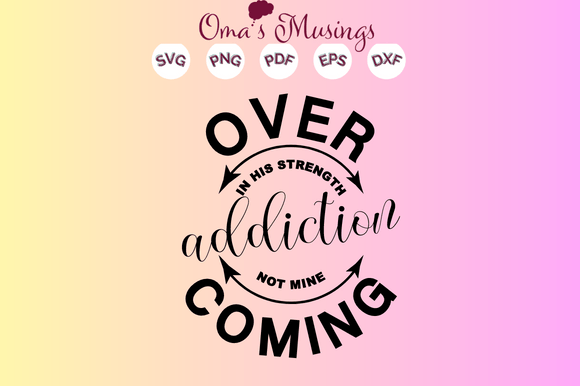
Overcoming Addiction SVG: Graphics for Crafts & Digital Sellers
As someone who’s launched over 200 digital product listings across Etsy, Creative Market, and Shopify—and built a six-figure printable shop—I opened Overcoming Addiction SVG expecting a niche but meaningful design. What I found wasn’t just a recovery-themed graphic—it was a quietly versatile graphic design asset with real commercial legs, if used thoughtfully.
The first impression? Clean, grounded, and emotionally resonant—not clinical or clichéd. It avoids cartoonish tropes or overly ornate flourishes. Instead, it leans into quiet strength: balanced negative space, legible yet expressive typography, and subtle visual rhythm that reads well at multiple sizes. The mood is hopeful but not saccharine—ideal for audiences seeking authenticity in mental wellness, sobriety support, and personal growth niches. This isn’t festive or playful; it’s elegant, modern, and intentional. That makes it especially valuable for creators building a premium-feeling digital product line around self-care, recovery communities, or therapeutic tools.
I tested Overcoming Addiction SVG across five real product scenarios before finalizing a listing:
- Printable wall art for recovery coaches’ client kits—paired with soft serif fonts and muted sage or charcoal backgrounds;
- Cricut project files for vinyl decals on water bottles and journals—verified clean cut lines and minimal anchor points;
- Sublimation designs on mugs and tote bags—confirmed crisp edges and no pixelation at 300 DPI in PNG;
- Canva template add-ons for sober-living planners—dropped the SVG into editable layers and adjusted stroke weight for consistency;
- Digital download bundles with matching affirmation quotes and minimalist icons—used the EPS and PDF versions for cross-platform compatibility.
Where it shines most is in product mockups and listing thumbnails. On white background mockups (like ceramic mugs or framed prints), the design commands attention without shouting—boosting perceived value and click-through potential. In themed collections—say, “Sobriety Support Bundle” or “Mindful Living Graphics”—it anchors visual storytelling and strengthens brand identity across related assets. Its adaptability also supports small business branding: a therapist can use it in email headers; a recovery podcast can feature it in social media graphics; a handmade business selling wellness journals can embed it into cover layouts.
It works best when given breathing room. Use it in large product previews, decorative layouts, printable products (planner stickers, greeting cards, invitation templates), and merchandise graphics where emotional resonance matters more than tiny detail. For social media promos, it scales cleanly into Instagram carousels and Pinterest pins—especially when paired with short, empowering copy like “One day at a time,” “My journey, my strength,” or “Celebrating every sober moment.”
But here’s where caution matters. Don’t force Overcoming Addiction SVG into contexts where clarity is compromised. Avoid using it as a sticker design smaller than 1.5 inches wide—the fine strokes lose definition. Skip dark backgrounds unless you’ve manually adjusted contrast or added a subtle drop shadow (the base PNG transparency holds up, but legibility suffers on navy or black without tweaks). And if you’re building a Cricut project for intricate layered vinyl, inspect the SVG paths first: some versions include overlapping outlines that may need simplification in Design Space.
Before publishing any Etsy product or print-on-demand listing, I always run these quick seller checks:
- Preview the file as a 200x200px thumbnail—does the core message still read clearly?
- Test print on both white and kraft paper—check color fidelity and contrast.
- Open the PNG in Photoshop or GIMP to verify full transparency (no hidden white edges).
- Import the SVG into Cricut Design Space and Silhouette Studio—confirm smooth cutting, no stray nodes.
- Verify resolution: all raster files should be 300 DPI at minimum 2400px width for standard print use.
- Organize delivered files with clear naming: “OvercomingAddiction_SVG”, “OvercomingAddiction_PNG_300dpi”, etc.—this reduces customer support tickets.
- Pair it intentionally: try pairing with a warm serif (e.g., Playfair Display) for elegance, a friendly sans serif (e.g., Montserrat) for modern clarity, or a restrained script font for handwritten warmth—never overcrowd with display fonts.
Crucially, I confirmed the commercial license covers finished goods—yes, you can sell t-shirts, mugs, and digital planners featuring this design, provided you don’t resell the raw files as standalone SVGs. That’s non-negotiable for anyone building a scalable creative marketplace presence.
Bottom line: Overcoming Addiction SVG isn’t a viral-bait graphic—but it’s a thoughtful, commercially viable illustration with staying power. It fits seamlessly into recovery-focused design bundles, adds depth to social media graphics, and elevates packaging design for wellness brands. For sellers targeting empathetic, values-driven buyers—therapists, life coaches, sober influencers, journal makers, and mindful crafters—it’s less about trend-chasing and more about meeting real emotional needs with integrity.
If your shop stands for authenticity over aesthetics alone, this SVG design earns its place—not as filler, but as foundation.